Triage Agent
Shipped · v0.4.0OpenAI Agents SDK — get_incident_context + get_historical_context. Category, priority, evidence plan, and investigation rationale. GET /incidents/{id}/triage.
Evidence / Investigation Agent
Roadmap · v0.5.0Collects metrics, logs, service health, and dependency status via MCP tools from the triage evidence plan.
Root Cause / Recommendation Agent
Roadmap · v0.5.0Correlates gathered evidence into root cause analysis and proposed remediation steps.
Livev0.4.0 · Temporal · Triage · Semantic memory→The AI Operations
AIRPSTACK
The AI Operations
Engineer
AI-Powered Incident Response Platform · Built by Arsalan Aziz
Autonomous agents that investigate incidents, collect evidence, identify root causes, and execute human-approved remediation.
Under construction
AIRP Operations ConsoleLive
Incidents
- #1842high
PostgreSQL write timeout
db-primary-01
- #1841medium
CPU saturation under load
api-gateway-03
- #1840low
DNS resolution failure
checkout-svc
Incident #1842
triage runningPostgreSQL write timeout
Primary replica exceeded 95% write latency for 10 minutes.
- Category
- database
- Priority
- P1
21:04:11 › PagerDuty webhook received incident.triggered
21:04:11 › Normalize → fingerprint → dedupe NEW incident
21:04:12 › Incident #1842 committed status=open severity=high
█
Built and Running
The Actual Product
Not mockups — screenshots of the AIRP operator console running against the working AIRP backend, showing real incidents and AI analysis output. Click any screenshot to view it full size.
Incident console
airp.local/incidents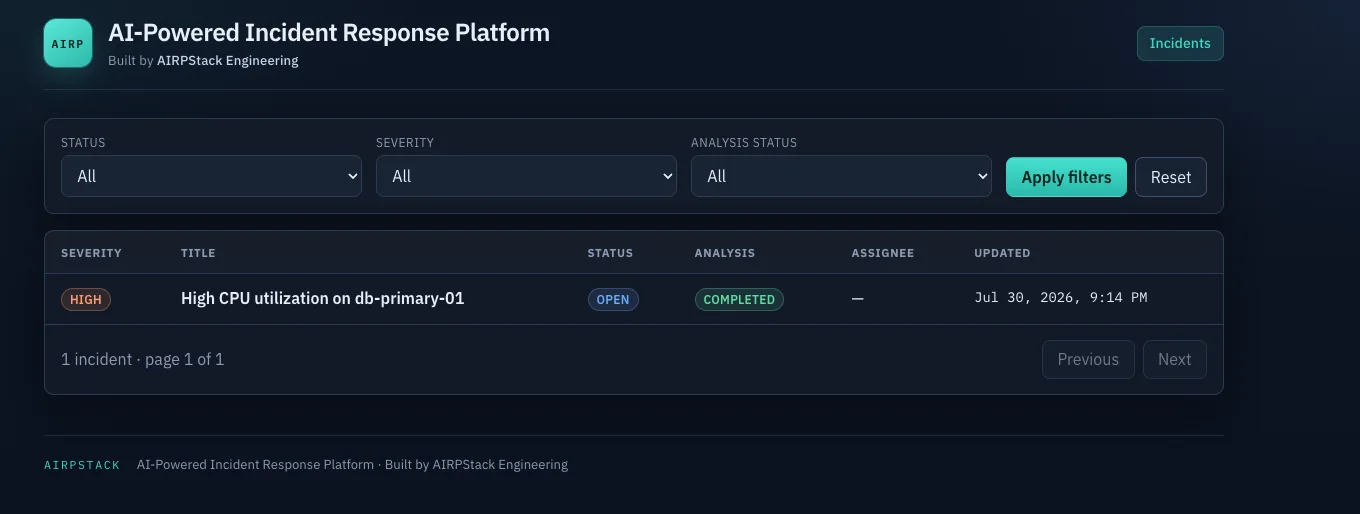
Filterable incident list — status, severity, triage state, assignee, and last update.
Agent analysis & timeline
airp.local/incidents/1842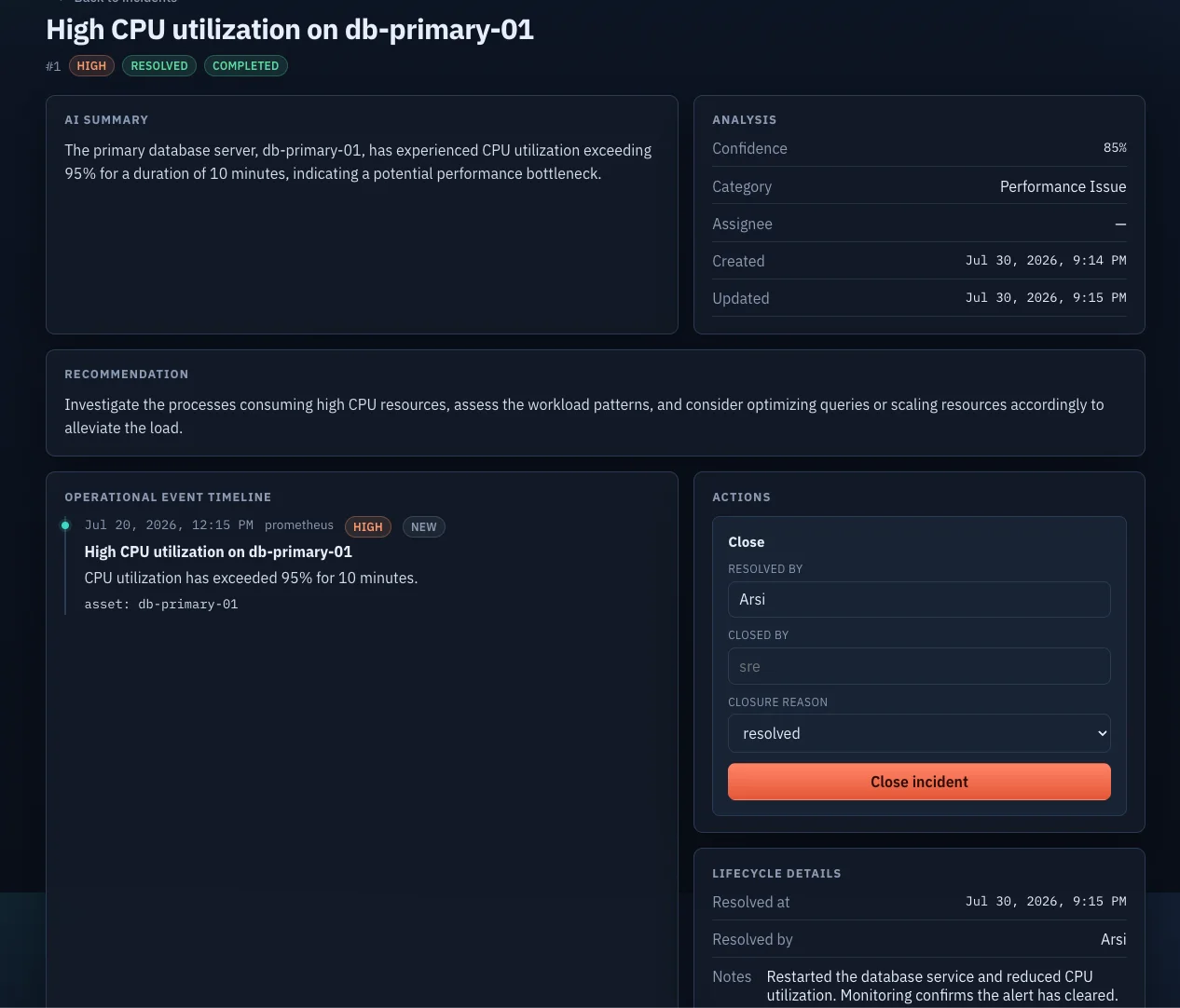
Incident detail — AI summary, recommendation, event timeline, and lifecycle actions.
Console states
airp.local/incidents?severity=critical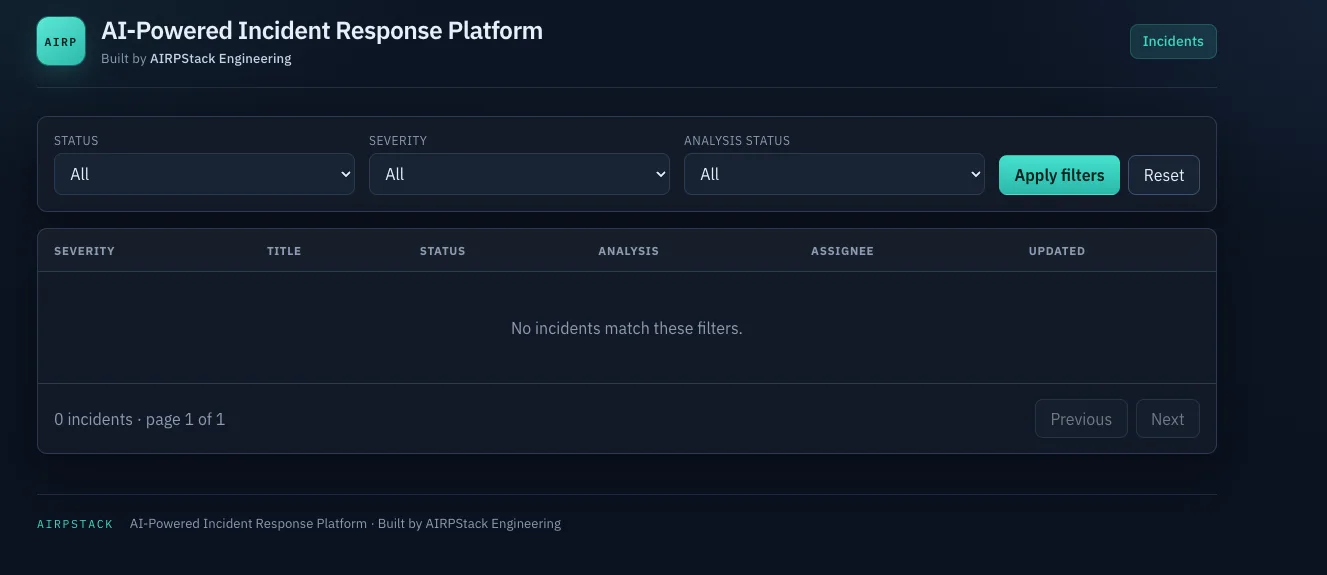
Deliberate empty and edge states — the console is a product surface, not a demo page.
Incident Investigation
A Real Outage, End to End
Walk a PostgreSQL write-timeout from PagerDuty through ingest, Temporal IncidentWorkflow, the live Triage Agent with semantic historical retrieval, and the operator console — the same path AIRP runs in v0.4.0.
POST /integrations/pagerduty/webhookjson
event_typeincident.triggered
servicepayments-api
titlePostgreSQL write timeout
assetdb-primary-01
severitycritical
A production write-path alert hits AIRP over Cloudflare Tunnel — not a toy payload, a real PagerDuty v3 incident.triggered webhook.
Pipeline status
- PagerDuty Alertshipped
- Temporal Workflowshipped
- Triage Agentshipped
- Semantic Memoryshipped
- Evidence Collectionroadmap
- Root Cause & Fixroadmap
The Problem
Too Many Tools, Too Little Time
Modern IT operations teams rely on disconnected tools — ServiceNow, Grafana, Prometheus, PagerDuty, Datadog, cloud providers, and internal dashboards. Engineers spend valuable time correlating alerts, searching historical incidents, gathering evidence, and executing repetitive runbooks.
High MTTR
Mean time to resolution suffers from manual correlation
Alert Fatigue
Unrelated events flood engineers without deduplication
Lost Knowledge
Institutional expertise walks out the door with every incident
AIRP becomes the orchestration layer across these systems — reducing MTTR, improving operational consistency, and preserving organizational knowledge.
Architecture
End-to-End Incident Flow
Click a stage to see the agents and platform components behind it — from PagerDuty through Temporal workflows, triage, semantic memory, human approval, and closed-loop learning.
Agent handoff
Triage Agent
Shipped · v0.4.0Runs on the agents-triage worker after ingest commits — grounded by Qdrant historical matches, structured output with evidence_to_collect for the next agent.
Evidence / Investigation Agent
Roadmap · v0.5.0Executes the triage evidence plan — system metrics, application logs, service health, and more.
Root Cause / Recommendation Agent
Roadmap · v0.5.0Reasons over collected evidence and proposes remediation with confidence scoring.
Open Source
AIRP Platform
AI-Powered Incident Response Platform — built by AIRPStack Engineering. Ingest, Temporal workflows, agentic triage with semantic historical memory, and a Next.js console.
External links are placeholders (example.com) until public release. Screenshots and architecture below are from the AIRP console (Triage Agent, semantic memory, PagerDuty).
AIRPSTACK
AI-Powered Incident Response Platform
Built by AIRPStack Engineering
- FastAPI
- PostgreSQL
- Temporal
- OpenAI Agents SDK
- Triage Agent
- Qdrant semantic search
- SentenceTransformers
- PagerDuty Webhooks
- Next.js Web UI
- Docker Compose
v0.4.0 · Temporal workflows · Triage Agent · semantic memory
PagerDuty / POST /events / POST /incidents
        │
        ▼
FastAPI commit → Postgres incident
        │
        ▼
Temporal IncidentWorkflow  incident-{id}
        ├── agents-triage  →  Triage Agent + get_historical_context
        └── embeddings     →  Qdrant upsert (airp-incidents)
        │
        ▼
Operator console  GET /incidents/{id}/triage
Architecture diagram
End-to-end AIRP architecture — PagerDuty ingress, Temporal IncidentWorkflow, Triage Agent with semantic historical retrieval, and the full multi-agent roadmap. See interactive flow for shipped vs planned stages.
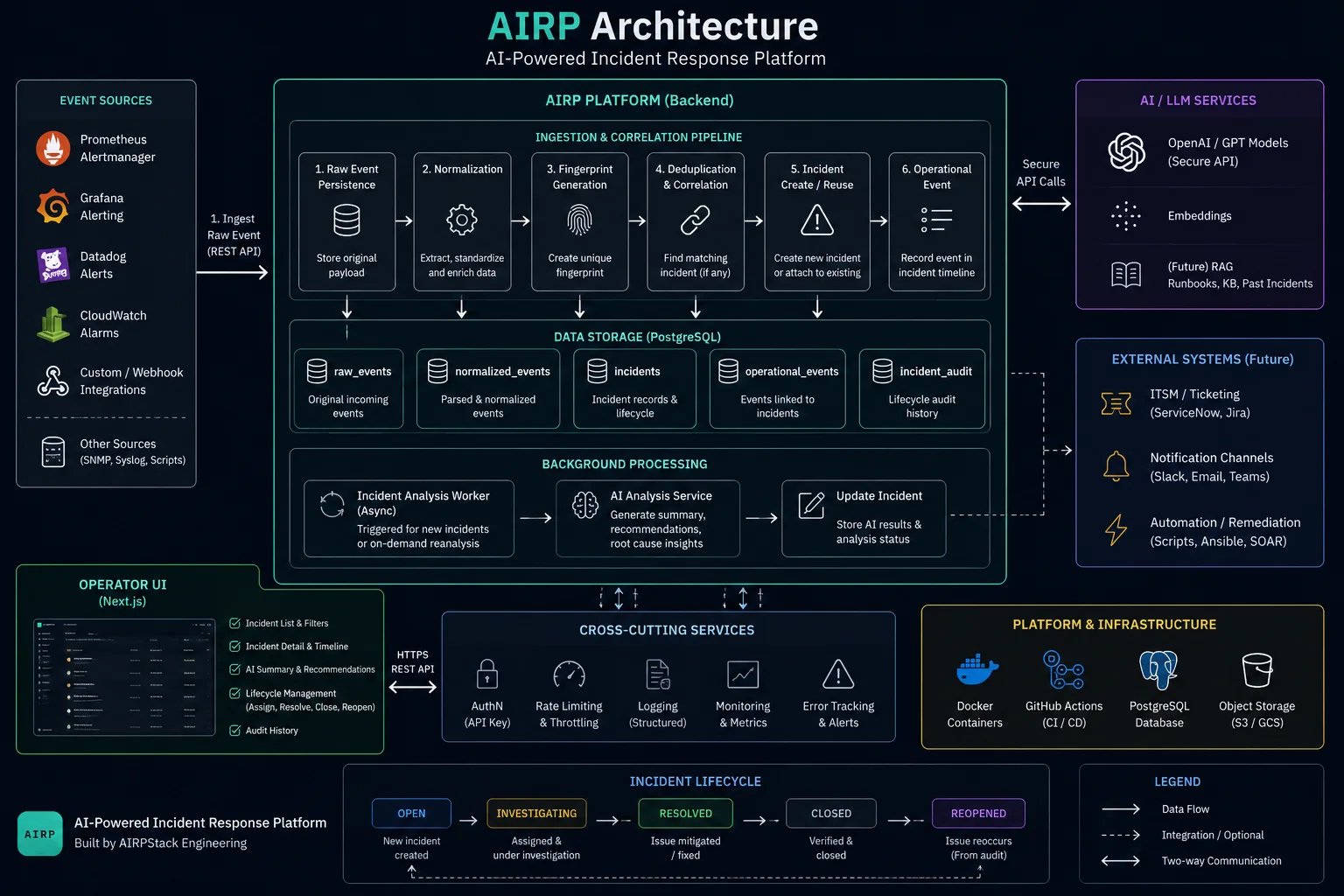
API documentation
REST endpoints (API key auth). Interactive OpenAPI is at /docs when running locally in development.
- POST/eventsIngest → normalize → dedupe → incident → IncidentWorkflow
- POST/events/rawPersist raw event only (debug)
- GET/eventsList operational events
- GET/events/{id}Operational event detail
- POST/integrations/pagerduty/webhookPagerDuty v3 webhook → EventIngest → IncidentWorkflow (pagey.ping → 200)
- GET/incidentsFilter by status / severity / triage_status + pagination
- POST/incidentsCreate incident and start IncidentWorkflow
- GET/incidents/{id}Incident detail
- GET/incidents/{id}/triageLatest structured triage result (category, evidence plan)
- PATCH/incidents/{id}Update lifecycle, assignment, closure
- POST/incidents/{id}/reopenReopen a closed incident (audit)
- GET/incidents/{id}/eventsEvents linked to incident
- GET/healthLiveness
- GET/health/readyReadiness (DB + LLM config)
Demo video
End-to-end walkthrough: ingest an event, dedupe, and LLM analysis.
Coming soon
Embed when recorded
Set airpMedia.demoVideoUrl to your YouTube or Vimeo embed URL in lib/airp-project.ts.
Tech Stack
What AIRP Is Built With
Production-grade tooling across AI, backend, frontend, and cloud — v0.4.0 ships Temporal workflows, the Triage Agent, and semantic historical memory.
Shipping today
- Python 3.12Platform core
- FastAPIAsync REST API
- PostgreSQLIncident, event & triage store
- SQLAlchemy + AlembicAsync ORM & migrations
- TemporalIncidentWorkflow, workers, pending-triage reconciler
- OpenAI Agents SDKTriage Agent — OpenAI is the only LLM provider
- QdrantVector store — semantic incident retrieval
- SentenceTransformersall-MiniLM-L6-v2 embeddings for index + search
- PagerDutyInbound v3 webhook connector
- Cloudflare TunnelSecure public webhook ingress
- Next.jsOperator console & this site
- PresidioPII / secret sanitization
- Docker ComposeAPI + web + Postgres + Qdrant + Temporal
- Cloudflare WorkersEdge deployment (OpenNext)
- GitHub ActionsCI/CD, tests, security scans
Building now · v0.4.0 follow-on
- Hugging Face datasetsExternalCuratedKnowledge schema exists; import gated off
- Runbook corpusIndex operational docs alongside incidents
- Closed-loop evalProve retrieved history changes triage quality
On the roadmap
- Grafana / DatadogAdditional alert connectors
- MCPEvidence collection & remediation tools
- Evidence / Investigation AgentExecute triage evidence plans
- SlackNotifications & approvals
Guiding Principles
Built for Trust
Every architectural decision answers one question: does this make AIRP a better AI Operations Engineer?
01
Evidence before action
02
Human approval before impactful remediation
03
Every action is auditable
04
Vendor-neutral integrations
05
Security by default
06
Every incident improves future investigations
Development Roadmap
Building in Phases
Four deliberate phases from core incident infrastructure to continuous learning — each mapped to platform components and workflow steps.
01
Event Intake & Incidents
Ingest → normalize → dedupe → incidents, plus open/investigating/resolved/closed lifecycle, filters, and pagination (AIRP v0.2).
Event IngestionDeduplication EngineIncident Service
02
AI Agents, Console & Connectors
v0.4.0: Temporal IncidentWorkflow after ingest; Triage Agent on agents-triage; operator console with triage and index_status; PagerDuty webhooks. Investigation agents still ahead.
Triage AgentTemporal WorkflowsOperator DashboardMonitoring GatewayInvestigation Engine
03
Approval & Execution Engine
Multi-agent orchestrator (triage, evidence, root cause, recommendation), human-in-the-loop approvals, and safe MCP-based remediation (AIRP v0.5.0+).
Policy EngineExecution Engine
04
Knowledge Base & Continuous Learning
v0.4.0 shipped semantic memory over AIRP incidents — embeddings worker indexes after triage, Qdrant top-5 retrieval, PostgreSQL hydration. ExternalCuratedKnowledge schema exists; Hugging Face import, runbooks, and live retrieval eval next.
Knowledge ServiceVerification EngineLearning Engine
The builder
Built by Arsalan Aziz
Senior Backend Engineer
Senior Backend Engineer building AI-native operational systems with Python, FastAPI, Temporal workflows, agentic triage, RAG, distributed systems, and infrastructure automation.
AIRPStack is not a prompt demo. It is a designed incident pipeline — ingest, Temporal workflows, a live Triage Agent with semantic historical memory, operator console, and Qdrant retrieval — built, deployed, and iterated as a production-shaped system.
- Python / FastAPI
- Temporal workflows
- Agentic triage
- RAG & retrieval
- Distributed systems
Under construction